Field Notes are quick sketches from the Biblical world – the people, places, rulers, etc. that show up in Scripture and shape the story around them.
Sometimes that still means looking at the armor Paul describes in Ephesians. If that’s what you’re after, you can find each piece of the armor in the sidebar links at right.
-
Field Notes: Where Were You When I Laid the Foundation of the Earth?
For most of the book of Job, Job wanted answers. He wanted to understand why everything he had built and loved had been taken from him, and he wanted God Himself to explain it.
By the time God answered him, Job had lost his children, his wealth and his health. He had spent chapter after chapter arguing with his friends about why this had happened and wanting an opportunity to make his case before God.
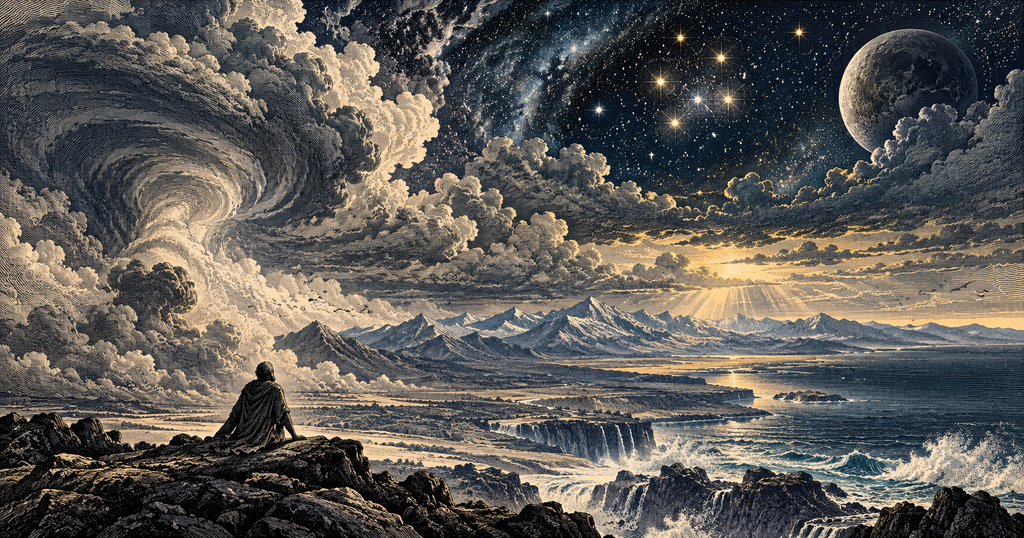
Then, in Job 38, God finally spoke. He didn’t begin by answering Job’s questions. He began asking His own. God spoke to Job from a whirlwind and asked, “Where were you when I laid the foundation of the earth?”
Job obviously wasn’t there, and that was the point. God continued by asking Job about things that existed long before him and operated far beyond his control. “Have you ever in your life commanded the morning?” “Have you entered the springs of the sea?”
Then the questions moved into the heavens. “Can you tie up the chains of the Pleiades?” “Do you know the ordinances of the heavens?”
God asked about weather, stars, animals, birth, death, light, darkness, snow, hail, rain and lightning. The questions continue for four chapters. They weren’t really a test of how much Job knew. They repeatedly showed him how much he didn’t.
Then God asked, “Will the faultfinder contend with the Almighty?”
Job finally answered. He said he was insignificant and had nothing to say. He put his hand over his mouth.
God wasn’t finished. He spoke again from the whirlwind and continued questioning Job, this time challenging whether Job could exercise the justice and power that belong to God. Then came Behemoth and Leviathan, two creatures Job could neither control nor overpower.
By the time God finished, He still had not given Job the explanation Job had spent so much of the book wanting. Instead, Job said something had changed in what he understood about God. He had spoken about things he didn’t understand, things too wonderful for him to know. He said, “I have heard of You by the hearing of the ear; but now my eye sees You.”
God’s questions didn’t give Job the reason for everything that had happened to him. They changed Job’s understanding of how much he could possibly know from where he stood.
Job wanted God to explain Himself.
God showed Job just how much bigger the picture was than Job could see.
Job 38–42
God has more questions. See Let Me Ask You Something: When God Asks a Direct Question.
-
Field Notes: Moses at the Well
Exodus 2 Moses arrives in Midian on the run from Pharoah…and sits down at a well. Jethro’s daughters come to draw water, but shepherds push them aside. Moses steps in, drives them off, and helps water the flock. That choice to defend the women changes the trajectory of Moses fortune. The daughters return home early,…
-
Field Notes: Rebekah at the Well
Genesis 24 In Scripture, wells were natural meeting places, and this one outside the city of Nahor becomes the setting where two paths cross at exactly the right time. Rebekah meets Abraham’s servant on a normal visit to a well to draw water. It doesn’t look like much at first. She’s just running an errand…and…
-
Field Notes: Mount Gerizim
Mount Gerizim rises just south of the ancient city of Shechem (modern Nablus). Across the valley to the north stands Mount Ebal. The two ridges face each other across the narrow valley where Israel once gathered. In the Bible, Mount Gerizim became known as the “mountain of blessings”. When Israel entered the Promised Land, the…
-
Field Notes: Mount Ebal
Mount Ebal sits just north of the ancient city of Shechem (modern Nablus) in the hill country of Samaria. Across the valley to the south stands Mount Gerizim. In the Bible, Mount Ebal is where Israel gathered after entering the Promised Land. Moses had commanded that an altar be built there and that the covenant…
-
Field Notes: Mount Nebo
This one is also in the Not A Mountain Club. Mount Nebo is a ridge in modern-day Jordan overlooking the Jordan Valley and the land of Israel. According to the Bible, this is the place where Moses stood and viewed the Promised Land before his death. From the summit, God showed Moses the land Israel…
-
Field Notes: Mount Hermon
Mount Hermon is the tallest mountain in Israel and sits along the border of Israel, Lebanon, and Syria. Because of its high elevation, its peaks are often snow-covered. In the Bible, Mount Herman marks the norther boundary of the land promised to Israel (Deuteronomy 3:8-9). The mountain is also mentioned in Psalm 133, which compares…