Field Notes are quick sketches from the Biblical world – the people, places, rulers, etc. that show up in Scripture and shape the story around them.
Sometimes that still means looking at the armor Paul describes in Ephesians. If that’s what you’re after, you can find each piece of the armor in the sidebar links at right.
-
Field Notes: Where Were You When I Laid the Foundation of the Earth?
For most of the book of Job, Job wanted answers. He wanted to understand why everything he had built and loved had been taken from him, and he wanted God Himself to explain it.
By the time God answered him, Job had lost his children, his wealth and his health. He had spent chapter after chapter arguing with his friends about why this had happened and wanting an opportunity to make his case before God.
Then, in Job 38, God finally spoke. He didn’t begin by answering Job’s questions. He began asking His own. God spoke to Job from a whirlwind and asked, “Where were you when I laid the foundation of the earth?”
Job obviously wasn’t there, and that was the point. God continued by asking Job about things that existed long before him and operated far beyond his control. “Have you ever in your life commanded the morning?” “Have you entered the springs of the sea?”
Then the questions moved into the heavens. “Can you tie up the chains of the Pleiades?” “Do you know the ordinances of the heavens?”
God asked about weather, stars, animals, birth, death, light, darkness, snow, hail, rain and lightning. The questions continue for four chapters. They weren’t really a test of how much Job knew. They repeatedly showed him how much he didn’t.
Then God asked, “Will the faultfinder contend with the Almighty?”
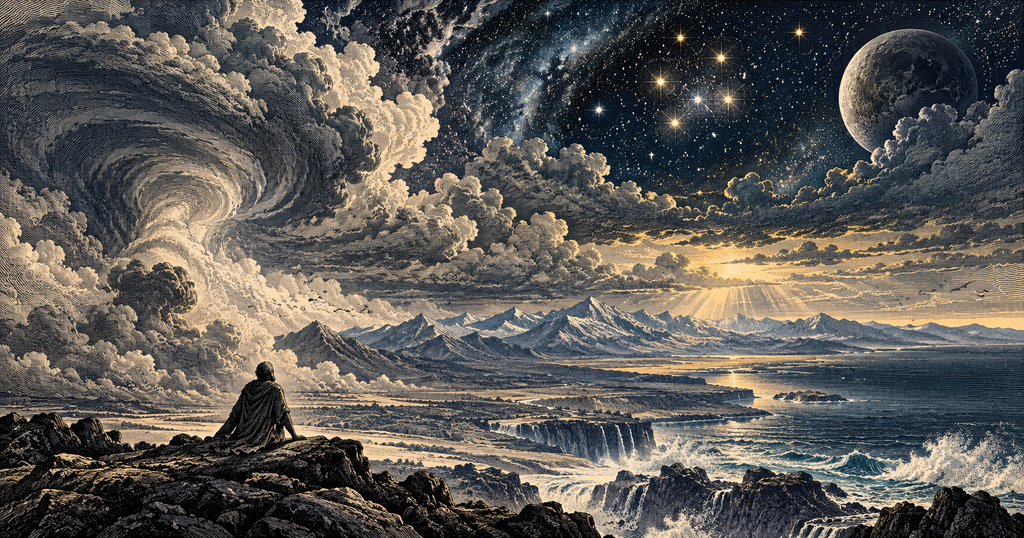
Job finally answered. He said he was insignificant and had nothing to say. He put his hand over his mouth.
God wasn’t finished. He spoke again from the whirlwind and continued questioning Job, this time challenging whether Job could exercise the justice and power that belong to God. Then came Behemoth and Leviathan, two creatures Job could neither control nor overpower.
By the time God finished, He still had not given Job the explanation Job had spent so much of the book wanting. Instead, Job said something had changed in what he understood about God. He had spoken about things he didn’t understand, things too wonderful for him to know. He said, “I have heard of You by the hearing of the ear; but now my eye sees You.”
God’s questions didn’t give Job the reason for everything that had happened to him. They changed Job’s understanding of how much he could possibly know from where he stood.
Job wanted God to explain Himself.
God showed Job just how much bigger the picture was than Job could see.
Job 38–42
God has more questions. See Let Me Ask You Something: When God Asks a Direct Question.
-
Field Notes: Mount Carmel
Another “not really a mountain” situation. Mount Carmel is actually a limestone ridge that runs along the Mediterranean coast in northern Israel. In the Bible, it is most famous as the place where the prophet Elijah confronted the prophets of Baal during the reign of King Ahab (1 Kings 18). When the prophet of Baal…
-
Field Notes: Mount Moriah
Mount Moriah is the modern day Temple Mount. It’s as simple as that. Underneath the raised platform of the Temple Mount is what the Bible calls Mount Moriah. It’s All the Same Hill Nerd Notes:–The staircase visible along the southern wall of the Temple Mount is known as the Southern Steps, one of the main…
-
Field Notes: Mount Zion
Mount Zion, not a mountain at all, is a historic hill in Jerusalem associated with the City of David and the early royal capital established by King David. In the Bible, Zion originally referred to the stronghold captured by David and later became closely connected with Jerusalem and the Temple Mount. Over time, the name…
-
Field Notes: Mount Ararat
The larger mountain pictured is Greater Ararat, located in eastern Turkey and visible from the Armenian capital of Yerevan. Standing at 16,854 feet, Greater Ararat is traditionally associated with the resting place of Noah’s Ark after the Flood (Genesis 8:4). Look how deep the water must have been for the ark to land on that…
-
Field Notes: Mount of Olives
The Mount of Olives is the ridge just east of Jerusalem, separated from the city by the Kidron Valley. It appears throughout the Gospels as on of Jesus’ regular places of prayer and teaching. From its slopes, Jesus delivered the Olivet Discourse about the end times (Matthew 24-25). At the foot of the mount is…
-
Field Notes: Mount Sinai/Horeb
Mount Sinai is the mountain where Moses received the Law and the Ten Commandments from God (Exodus 19-20). The mountain is sometimes called Horeb in Scripture, and the two names generally refer to the same mountain or the surrounding mountain region.