Cain and Abel both brought offerings to God. Abel brought from the firstborn of his flock and their fat portions, while Cain brought an offering from the fruit of the ground. God accepted Abel and his offering but did not accept Cain and his offering. Genesis does not explicitly tell us exactly why. Hebrews 11:4 says Abel offered his sacrifice “by faith,” and 1 John 3:12 describes Cain’s deeds as evil and Abel’s as righteous, so Scripture does give us clues that the difference involved more than simply one brother bringing meat and the other bringing produce. I don’t understand why God would be mad at that, but here is your random reminder that I am not a theologian, Bible scholar, or seminary graduate. I am just a regular Jill fact-finder and amateur understander.
Whatever the reason, Genesis leaves no doubt about Cain’s reaction. He became very angry, and his face showed it. God responded by asking him, “Why are you angry? And why is your face gloomy?” God obviously knew Cain was angry, but He used the questions to confront Cain about what was happening inside him.
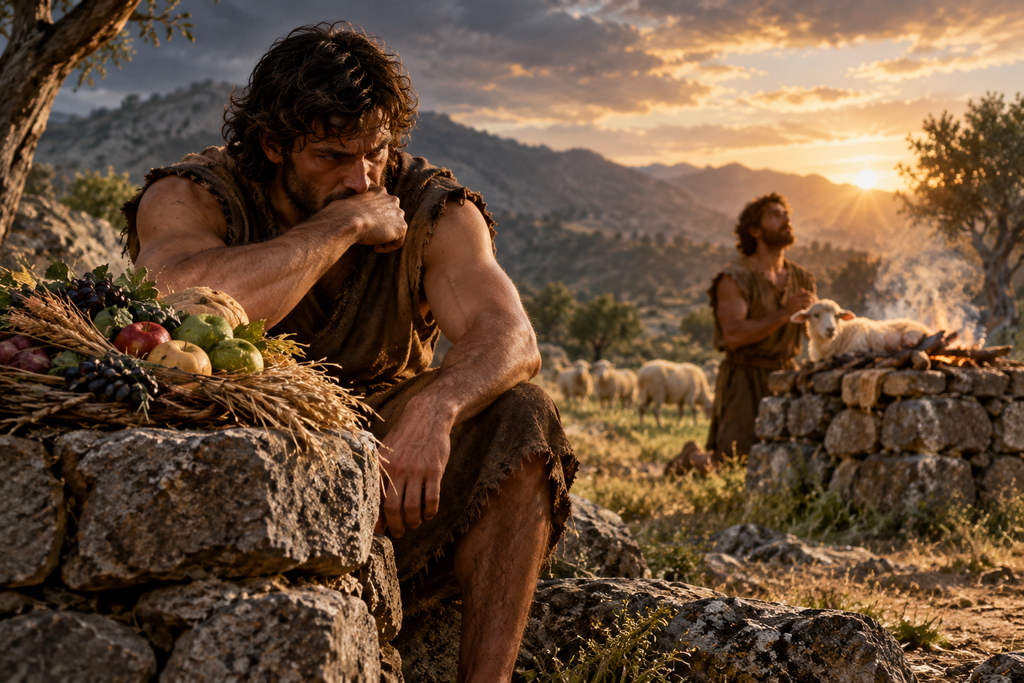
God continued, “If you do well, will your face not be cheerful? And if you do not do well, sin is lurking at the door; and its desire is for you, but you must master it.” Cain had not killed Abel yet. God confronted him while the problem was still in the early stages of sin (anger) and warned him where that anger could lead.
God’s warning fell on deaf ears. He took Abel into a field and killed him. God then asked, “Where is Abel your brother?” Obviously, God already knew the answer. Cain knew the answer too, but instead of admitting what he had done, he lied: “I do not know.” Then came what may be the first recorded instance of back-talkery: “Am I my brother’s keeper?”
God answered Cain with another question. “What have you done?” He then told Cain that Abel’s blood was crying out to Him from the ground. God’s questions were never about finding out what happened. Cain had been given opportunities on both sides of his sin. Before Abel’s murder, God questioned Cain about his anger and warned him where it could lead. After the murder, God questioned him again and gave him an opportunity to acknowledge what he had done.
Cain’s own question, “Am I my brother’s keeper?” was meant to deflect responsibility. How should I know where Abel is? Is keeping track of him my job? Cain knew exactly where his brother was because Cain knew exactly where he left him.
Maybe the most interesting answer to Cain’s question comes from what happened before he ever asked it. God had already warned Cain to keep watch over something else – himself. Sin was “hanging out at the door,” but Cain was told that he must master it.
He didn’t.
God has more questions. See Let Me Ask You Something: When God Asks a Direct Question.