Jeremiah was young when God called him to be a prophet. Jeremiah immediately objected that he didn’t know how to speak because of his youth. God told him not to say he was too young. He would go where God sent him, say what God commanded him to say, and God would be with him.
Then God asked Jeremiah, “What do you see, Jeremiah?”
Jeremiah answered that he saw the branch of an almond tree. God told him, “You have seen well, for I am watching over My word to perform it.” He meant that He was watching to make sure that what He had said actually happened. He would carry out what He had spoken.
Just as He did with Amos and his basket of summer fruit, God used two similar-sounding Hebrew words to connect what Jeremiah saw with what it meant. According to the notes in Bible Gateway, the Hebrew word for “almond” is shaqed, while the word for “watching” is shoqed. The notes specifically identify this as wordplay. God showed Jeremiah shaqed, an almond branch, and then told him He was shoqed, watching over His word.
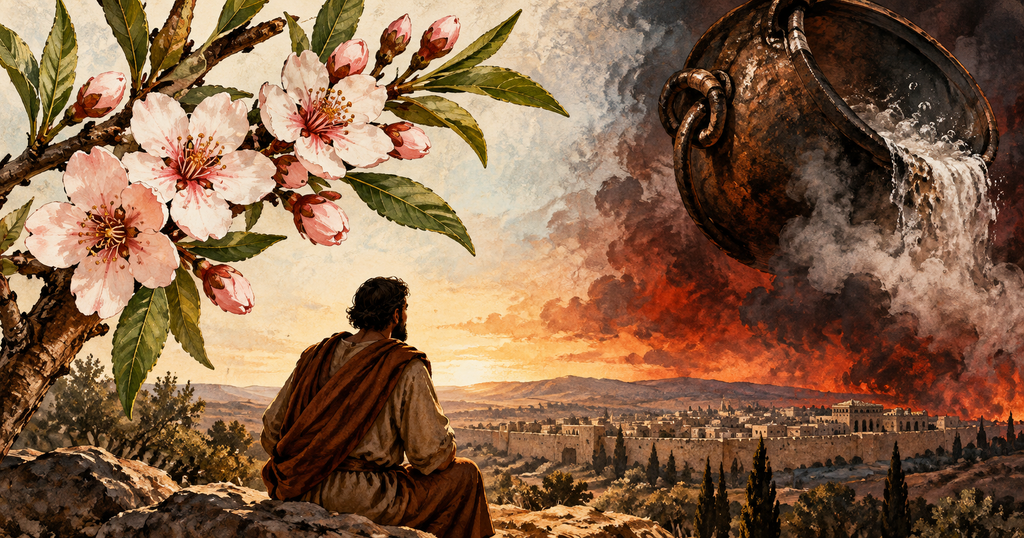
Then God asked Jeremiah again, “What do you see?”
This time Jeremiah saw a boiling pot facing away from the north. God explained that evil would be unleashed from the north against the people of Judah because they had turned away from Him and worshiped other gods.
Years later, God asked Jeremiah the same kind of question again. He showed him two baskets of figs placed before the temple and asked, “What do you see, Jeremiah?” One basket contained very good figs. The other contained figs so bad they could not be eaten.
God used the two baskets to describe two groups of people from Judah. The good figs represented the exiles He would watch over and eventually bring back. The bad figs represented those who remained under judgment. Once again, God began with something Jeremiah could see and then explained what it meant.
Jeremiah’s questions were not limited to visions. During the Babylonian siege of Jerusalem, God told Jeremiah to buy a field even though the city was about to fall. It made little practical sense. Jeremiah obeyed, but he also prayed about everything that was happening around him. God answered him with another question. “Is anything too difficult for Me?”
Jeremiah had spent years watching God’s warnings come true. Now God was asking him to trust that His promises of restoration would come true as well. The same God who had been watching over His word from the beginning was still watching over it.
An almond branch, a boiling pot, two baskets of figs and a field purchased while a city was under siege all became ways God taught Jeremiah to look beyond what was directly in front of him. God kept asking Jeremiah what he could see, then showing him that there was more happening than what his eyes alone could tell him.
Jeremiah 1:4–16; 24:1–10; 32:1–44
God has more questions. See Let Me Ask You Something: When God Asks a Direct Question.