Amos did not start out as a prophet. He was a shepherd and a grower of sycamore figs when God took him from tending the flock and sent him to prophesy to Israel.
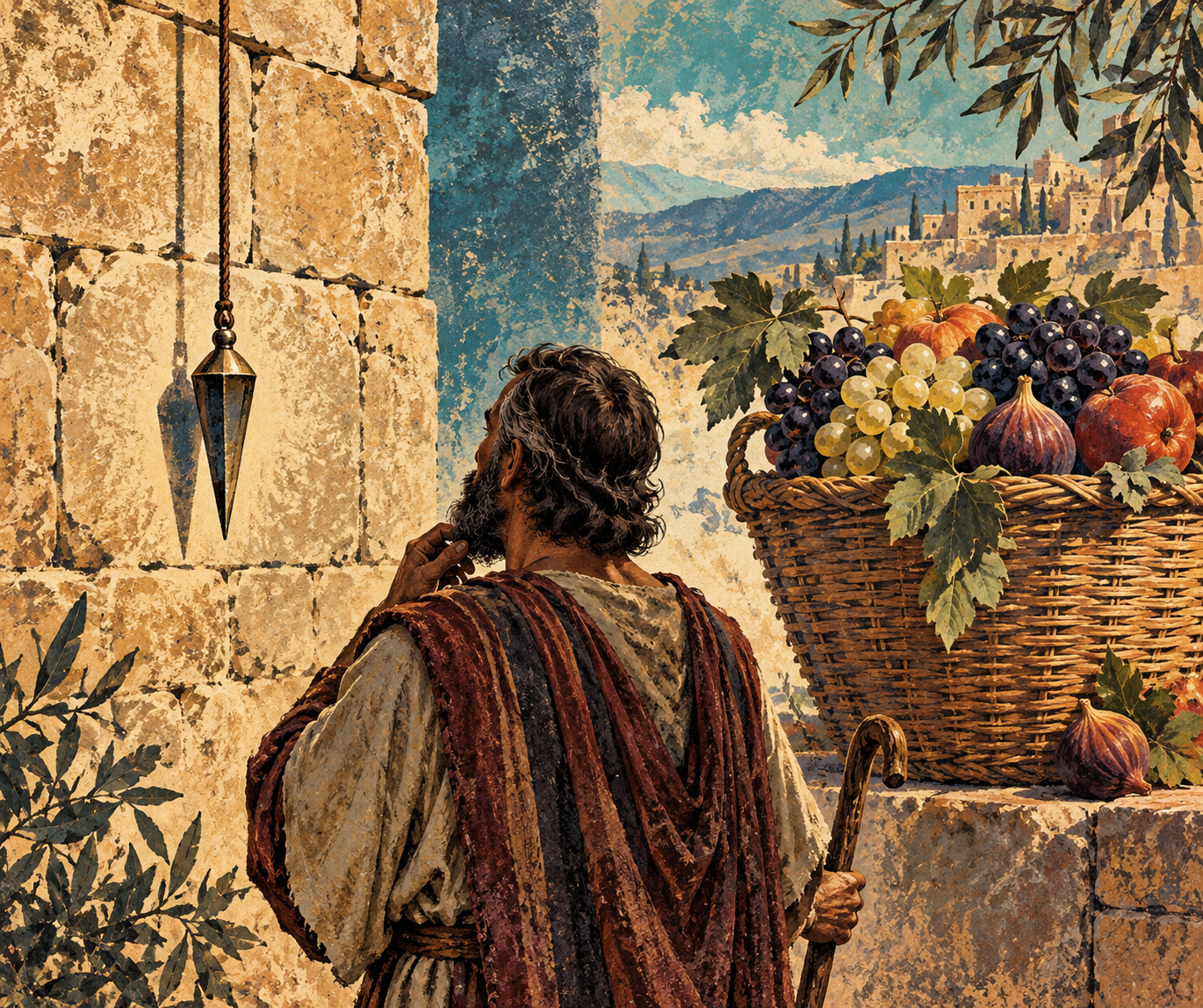
God gave Amos a series of visions warning that judgment was coming. In one of them, Amos saw the Lord standing beside a wall with a plumb line in His hand. God asked him, “What do you see, Amos?”
Amos answered, “A plumb line.”
A plumb line was a tool used to determine whether something was straight. God told Amos He was setting a plumb line among His people Israel. They were being measured against His standard, and God would no longer overlook what He found.
A little later, God showed Amos another vision and again asked, “What do you see, Amos?”
This time Amos answered, “A basket of summer fruit.”
There is something happening in Hebrew that we completely miss in English. The word for “summer fruit” is qayits (קַיִץ), while the word for “end” is qets (קֵץ). Amos sees qayits, and God tells him the qets has come for Israel. The basket of ripe fruit became a picture of Israel having reached the end.
Both times, God showed Amos something ordinary and asked him to identify what he was seeing before explaining what it meant.
The plumb line illustrated God measuring Israel’s uprightness. The summer fruit seems to me to work almost like a word association. Amos saw qayits, “summer fruit,” and God answered with qets, “end.” It’s basically wordplay using similar-sounding words used as a teaching device. The sound of “the thing” Amos sees becomes the hook for what God is announcing. But God wasn’t just playing word games with Amos. “Summer fruit” is late-season fruit, so God needed the end of season fruit to signify the Israel was nearing their “end of season”.
Amos 7:7–9; 8:1–3
God has more questions. See Let Me Ask You Something: When God Asks a Direct Question.