Field Notes are quick sketches from the Biblical world – the people, places, rulers, etc. that show up in Scripture and shape the story around them.
Sometimes that still means looking at the armor Paul describes in Ephesians. If that’s what you’re after, you can find each piece of the armor in the sidebar links at right.
-
Field Notes: Where Were You When I Laid the Foundation of the Earth?
For most of the book of Job, Job wanted answers. He wanted to understand why everything he had built and loved had been taken from him, and he wanted God Himself to explain it.
By the time God answered him, Job had lost his children, his wealth and his health. He had spent chapter after chapter arguing with his friends about why this had happened and wanting an opportunity to make his case before God.
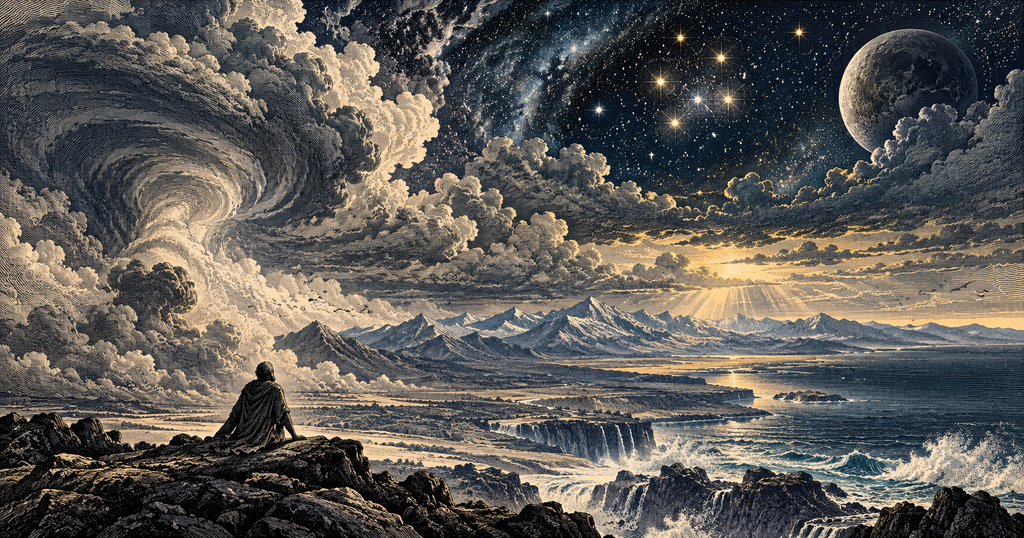
Then, in Job 38, God finally spoke. He didn’t begin by answering Job’s questions. He began asking His own. God spoke to Job from a whirlwind and asked, “Where were you when I laid the foundation of the earth?”
Job obviously wasn’t there, and that was the point. God continued by asking Job about things that existed long before him and operated far beyond his control. “Have you ever in your life commanded the morning?” “Have you entered the springs of the sea?”
Then the questions moved into the heavens. “Can you tie up the chains of the Pleiades?” “Do you know the ordinances of the heavens?”
God asked about weather, stars, animals, birth, death, light, darkness, snow, hail, rain and lightning. The questions continue for four chapters. They weren’t really a test of how much Job knew. They repeatedly showed him how much he didn’t.
Then God asked, “Will the faultfinder contend with the Almighty?”
Job finally answered. He said he was insignificant and had nothing to say. He put his hand over his mouth.
God wasn’t finished. He spoke again from the whirlwind and continued questioning Job, this time challenging whether Job could exercise the justice and power that belong to God. Then came Behemoth and Leviathan, two creatures Job could neither control nor overpower.
By the time God finished, He still had not given Job the explanation Job had spent so much of the book wanting. Instead, Job said something had changed in what he understood about God. He had spoken about things he didn’t understand, things too wonderful for him to know. He said, “I have heard of You by the hearing of the ear; but now my eye sees You.”
God’s questions didn’t give Job the reason for everything that had happened to him. They changed Job’s understanding of how much he could possibly know from where he stood.
Job wanted God to explain Himself.
God showed Job just how much bigger the picture was than Job could see.
Job 38–42
God has more questions. See Let Me Ask You Something: When God Asks a Direct Question.
-
Field Notes: Why Did Sarah Laugh?
God had already promised Abraham that he would become the father of a great nation, but there was an obvious problem. Abraham and Sarah still had no children together, Abraham was nearly 100 years old, and Sarah was about 90. When God told Abraham that Sarah would have a son, Abraham laughed. Genesis 17 says…
-
Field Notes: Why Are You Angry?
Cain and Abel both brought offerings to God. Abel brought from the firstborn of his flock and their fat portions, while Cain brought an offering from the fruit of the ground. God accepted Abel and his offering but did not accept Cain and his offering. Genesis does not explicitly tell us exactly why. Hebrews 11:4…
-
Field Notes: Who Told You You Were Naked?
God’s first question after Adam and Eve ate from the tree was, “Where are you?” Adam and Eve had already realized they were naked, sewn fig leaves together to cover themselves, and hidden when they heard God walking in the garden. God knew where they were. He also knew what they had done. So “Where…
-
Field Notes: Nile River
The Nile River was the lifeline of ancient Egypt, providing water, food, and transportation. It is where Moses was placed in a basket and found by Pharoah’s daughter (Exodus 2). It is where the first plague occurred, when the water was turned to blood (Exodus 7). The Nile played a central role in Egypt’s power…
-
Field Notes: Mediterranean Sea
The Mediterranean Sea formed the western boundary of the land of Israel. It was a major route for travel and trade in the ancient world. The Apostle Paul traveled across it during his missionary journeys, including his voyage to Rome. It is where Paul was shipwrecked on his way to Rome (Acts 27). Jesus’s ministry…
-
Field Notes: Dead Sea
The Dead Sea is a salt lake located at the lowest point on earth. Water flows from the Sea of Galilee (a place with much life) through the Jordan River into the Dead Sea. The Dead Sea has no outlet, so water flows in but does not flow out, resulting in the inability for any…