Looking for something more wholesome than “1923”? Up Faith & Family on Amazon Prime offers feel-good shows that won’t embarrass your conscience. Try it here
-
Still Waters: Walkin’ in the Son
What God Reminds Me of Daily
“If anyone serves Me, he must follow Me; and where I am, there My servant will be also…”
John 12:26Everybody loves a good walk every now and then. I am a lukewarm hiker. I like walkin’ in the sun, the shade, and the rain. I like dirt and foliage, birds and critters. I have hiked local Middle Tennessee parks, and I have hiked The Mighty Five in Utah.
Sometimes the trail is obvious. It’s a well-worn dirt path, and it’s clear which direction to take. Sometimes, though…the trail disappears and you don’t know which way to go. When you are lost, the main thing you need is a destination. Then you could probably make good use of a compass. But if you’ve resolved not to do all things on your own, it’s best to have an experienced guide.
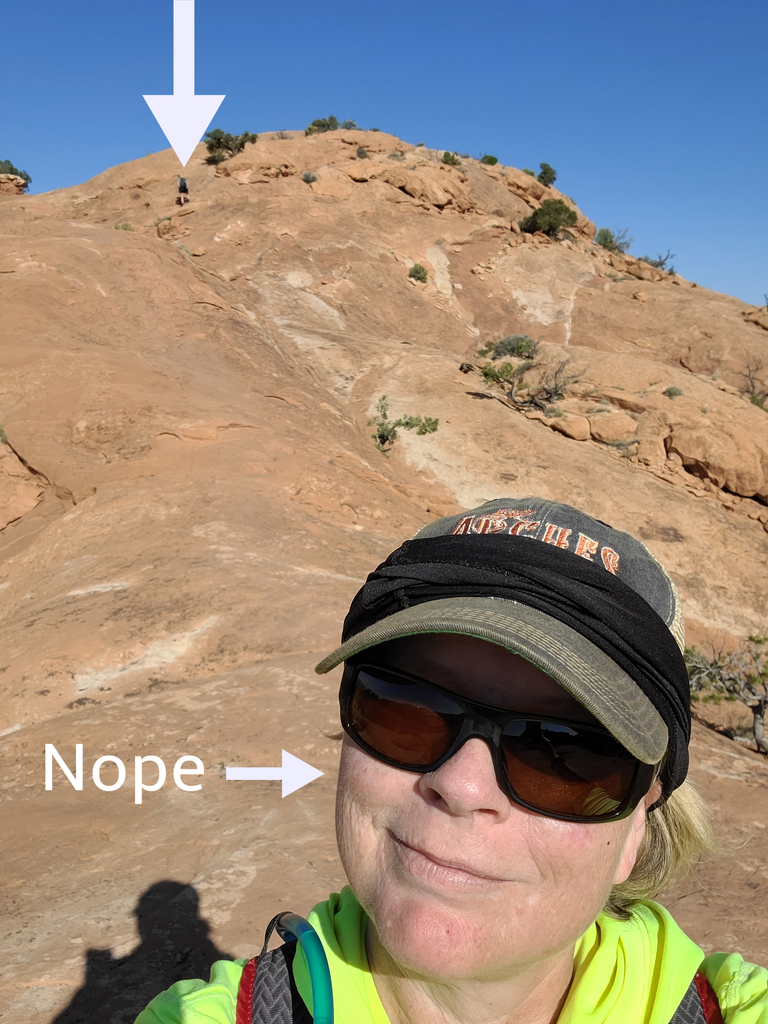
On the Mighty Five trip, my hiking partner and I went to Dead Horse Point State Park near Arches National. There were some craters we wanted to see. So, we hiked to the first overlook, and it was amazing. The second overlook was something I was not willing to try, but my partner forged ahead. I told her I would sit “over here in this nice, smooth crater” and take pictures from afar so she could tell people she did it.
She was climbing a rock face, slowly sliding laterally one move at a time. I couldn’t really tell where she was going, but I was taking pictures of her Spidey-skills. After I had enough proof-pictures (which turned out to be blackmail pictures…. ), I closed my eyes and crossed my ankles, relaxing in the smooth bowl of the crater for a moment when suddenly I hear an expletive followed loudly by, “I went the wrong way!”
This is usually what happens when you don’t have a direction, a compass, or a guide.
She made it, all was well, and we laughed about it for hours. But man, it would have been easier if we had a tour guide or at least someone who had hiked that route at least once before leading the way.
Enter Jesus. He offered Himself up to us as the guide for the journey that is our whole lives and said, “Follow me.”
By default, the word “follow” means you have to move. You can’t stay where you are because that would be “staying”, not “following”. Movement alone is not discipleship, though. You have to have direction for your movement to be purposeful. The direction is just Jesus. He is the compass. He is the guide. Jesus is the Sherpa and the travel plan (the Way!) all rolled up into one.
Following happens one step at a time, but we don’t have to worry about the step after that as long as we stay close to Him. It doesn’t matter what’s ahead. He is leading us there, and if we follow closely, then He is with us by default when we arrive at “what’s ahead”.
Those are pretty words, Jenny, but Jesus is not actually in my bedroom when I wake up trying to hand me a cup of coffee! Okay then. No more parables. The way to stay close to Jesus is by staying in the Word and reading Scripture. It’s amazing how the Spirit leads us to passages when we really need it. A great example is in a previous Still Waters post called “Fish and Visitors“. I got confused and a little doubt crept in, but I was led to a Scripture that cleared it all up for me.
Prayer is another way to follow the Lord’s path. It keeps Him close to us and keeps us close to Him.
Hearing and listening to the Spirit is yet another way to stay in Jesus’ shadow. Okay, that clerk at Sam’s was a jerk, and I could have made a scene, but the Holy Spirt said “no“! So I just paid for my stuff and left. I was harnessed by the Spirit! (See “Harnessed” for more on Biblical meekness). If you know me or people like me, then you know that day at Sam’s was a modern-day miracle. That’s me in the shadow of Jesus….because that clerk really was rude and deserved a smite!
🎵Walkin’ in the Sun
Funny story. I was a huge Janet Jackson fan back in the day. I liked Janet so much I bought a Herb Alpert CD just because Janet’s song “Diamonds” was on it.
So because I followed Janet, I discovered Lisa Keith. She and Janet were both featured vocalists on “Diamonds”, but I had no idea who Lisa Keith was. But when she put out a solo album, I was probably the first person in Knoxville, Tennessee to buy the CD.
She had one hit you may have heard. It was called “Better Than You“. It was the first single on the CD, but the real gem was “Walkin’ in the Sun”. This song has played in the background of my life for more than thirty years. After you read this Still Waters entry, take a minute and give this song some love. Feel it.
Following also requires leaving something behind. The disciples left nets, boats, jobs, routines. Not because those things were necessarily bad, but because you can’t go somewhere new while refusing to leave where you are.
Over the decades, I have thought about what I’m leaving in order to follow Jesus. It’s been different things at different times, but in this sixth decade of my life, the things I am trying to leave behind are impatience, anger, and resentment. It’s not easy, and it’s not always precise, thorough, or complete. I follow Jesus, but sometimes I get lost in the backcountry because I want to pet a snake, and Jesus has to come and get me and lead me back to the trail.
It’s mentally hard to follow anyone or anything just one step at a time, but Jesus also knows how hard it is for us. Sometimes we want to move at a faster pace. Sometimes we want to avoid the high grass, and sometimes we would rather take a boat than swim.
But Jesus is the One who sets the pace, and Jesus leads the way. We have to give control of the leadership, the pace and the direction to Jesus. At this point in my life, I certainly don’t want to be out front. I guarantee you I will be hollering out “I went the wrong way!” in record time if I am ever the lead dog. Sorry to disappoint, but I am not the torchbearer! (Shout out to my alma mater the University of Tennessee at Knoxville – official magazine “Torchbearer“).
And since we’re following the Guide’s pace, what happens if He stops? If the Guide stops, you stop. Because nobody hikes forever. Jesus withdrew from people. He slept, ate, and spent a lot of time alone in prayer. Rest is part of the hike! You aren’t going to have the energy to follow if you don’t rest, refresh, and recuperate.
If you have ever been in a single-file line for anything, you know the “bob and weave” that inevitably occurs when you try to look around the person in front of you to see where you are going or how far it is to the destination. Do you trust your Guide, though? I certainly do. I would follow Him with my eyes closed. If that is true, then why worry about what’s ahead? Live where your feet are. Be present right where you are. Take the energy you were using to worry about the next steps and your plans for the future and funnel it back into today.
I try to remind myself that Jesus never gave Peter a 30-year itinerary. Peter found out where they were going by just going. He did not know, just as we do not know, where the path was going to lead. But it doesn’t matter. Even a blind man can tell when he’s walkin’ in the Son.
Prayer for When I Wander Into the Backcountry
Lord, when I am lost, help me stop and look for You. When I want to choose my own path, remind me that You already know the way. Help me follow at Your pace, rest when You stop, and trust You with what I cannot see ahead. Keep me so close that I never have to wonder which way You went. Amen.
-
Still Waters: Knowing Me, Knowing You
✦ ✨ ✦ ✦ ✦ ✦ ✨ ✦ ✦ ✨ ✦ ✦ ✦ ✦ ✨ ✦ First, a word about Dolly… This is my first Still Waters since we lost Dolly Parton, and since I’m a Tennessean, I could not let the moment pass without saying something about a woman whose music, faith, humor, and…
-
Still Waters: Fish and Visitors
What God Helped Me Discover This Week“It is the glory of God to conceal a matter, but the glory of kings is to search out a matter.”Proverbs 25:2 Recently I was watching a lecture series from The Great Courses called “History of Christianity” on Prime. The professor, Luke Timothy Johnson of Emory University, was talking…