
Images, Idols & Idolatry from Genesis to Revelation
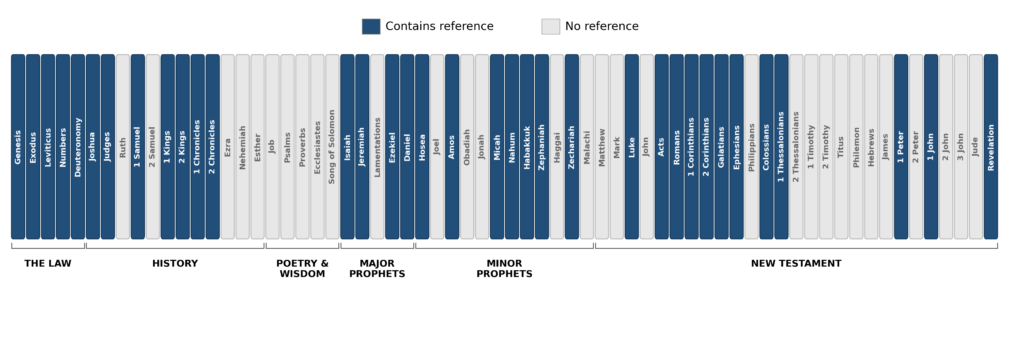
From Genesis to Revelation, this timeline traces idols in the Bible, along with idolatry, images, false gods, and God-directed physical objects or reminders. 35 of the 66 books contain at least one of these references. The image below is just an at-a-glance visual of the books that contain these references (blue). I feel like this is a pretty important thing if it is mentioned this many times in this many books.
The timeline below the bookshelf is filterable by label. Just click one of the colored bubbles at the top if you want to filter by reference type. And don’t forget to scroll…because there’s a lot of ’em. 160 in all (that I found…)!
Rachel Steals Laban’s Household Gods
Rachel takes Laban’s household gods when Jacob’s family leaves his household.
Genesis 31:19–35Jacob’s Household Puts Away Foreign Gods
Jacob tells his household to remove their foreign gods before going up to Bethel.
Genesis 35:1–4The Feast as a Sign and Reminder
Israel is told to observe the Feast of Unleavened Bread, which is described as a sign on the hand and a reminder on the forehead.
Exodus 13:3–10The Firstborn as a Sign and Reminders
The consecration of the firstborn is described as a sign on the hand and a reminder worn on the forehead, recalling the Exodus.
Exodus 13:11–16A Jar of Manna Kept for Future Generations
God commands that an omer of manna be kept so later generations can see the bread He provided in the wilderness.
Exodus 16:32–34No Other Gods or Carved Images
Israel is commanded not to have other gods, make carved images or likenesses for worship, or bow down to them.
Exodus 20:3–6No Gods of Silver or Gold
Israel is told not to make gods of silver or gold alongside the LORD.
Exodus 20:22–23Do Not Serve Their Gods
Israel is told not to worship the gods of the nations and to tear down their sacred pillars.
Exodus 23:23–24Cherubim on the Mercy Seat
God instructs Israel to make two gold cherubim for the mercy seat on the ark.
Exodus 25:18–22Cherubim Woven into the Tabernacle
God instructs Israel to make tabernacle curtains and the inner veil with cherubim worked into the fabric.
Exodus 26:1, 31–33Memorial Stones on the Priestly Garments
God directs that engraved stones bearing the names of Israel be placed on the ephod and breastpiece as memorials before Him.
Exodus 28:9–21The Golden Calf
Aaron makes a golden calf, and Israel worships and sacrifices before it.
Exodus 32:1–35Tear Down Pagan Worship Objects
Israel is told to tear down pagan altars and Asherim and not to make cast metal gods.
Exodus 34:12–17Do Not Turn to Idols
Israel is told not to turn to idols or make cast metal gods.
Leviticus 19:4Sacrifices to Molech
Israel is forbidden to give children to Molech.
Leviticus 20:1–5No Idols, Pillars or Figured Stones
Israel is forbidden to make idols, erect sacred pillars, or set up figured stones for worship.
Leviticus 26:1Tassels as a Reminder
God instructs Israel to wear tassels with a blue cord so they will look at them, remember His commandments, and obey them.
Numbers 15:37–41The Censers Become a Memorial
God directs that the rebels’ bronze censers be hammered into plating for the altar as a sign and memorial to Israel.
Numbers 16:36–40Aaron’s Staff Kept as a Sign
After Aaron’s staff buds, God instructs Moses to keep it before the testimony as a sign against rebellion.
Numbers 17:1–11The Bronze Serpent
God instructs Moses to make a bronze serpent so those who look at it after being bitten may live.
Numbers 21:4–9Baal of Peor
Israel joins in sacrifices to the gods of Moab and worships Baal of Peor.
Numbers 25:1–5Destroy the Images of Canaan
Israel is told to destroy the inhabitants’ figured stones, cast metal images, and high places.
Numbers 33:50–52No Form at Horeb
Israel is warned not to make an image in the form of people, animals, birds, creatures, fish, or heavenly bodies for worship.
Deuteronomy 4:15–19Do Not Make a Carved Image
Moses warns Israel not to make carved images and foretells judgment if they turn to manufactured gods.
Deuteronomy 4:23–28The Command Repeated
The prohibition against other gods, carved images, and bowing to them is repeated.
Deuteronomy 5:7–10Signs, Reminders and Doorposts
Israel is instructed to keep God’s words before them, including binding them as signs and writing them on doorposts.
Deuteronomy 6:4–9Destroy Altars, Pillars and Asherim
Israel is told to tear down pagan altars, smash sacred pillars, cut down Asherim, and burn carved images.
Deuteronomy 7:1–6Burn Their Carved Images
Israel is told to burn carved images and not bring a detestable thing into the house.
Deuteronomy 7:25–26Moses Recounts the Golden Calf
Moses recounts Israel’s calf and his destruction of the idol.
Deuteronomy 9:7–21Signs, Reminders and Doorposts Repeated
Israel is again told to bind God’s words as a sign on the hand, a reminder worn on the forehead, and to write them on doorposts.
Deuteronomy 11:18–20Destroy the Worship Sites
Israel is told to destroy pagan worship sites, altars, pillars, Asherim, and carved images.
Deuteronomy 12:1–4Reject Calls to Other Gods
Israel is warned against prophets, relatives, or cities that entice people to serve other gods.
Deuteronomy 13:1–18No Asherah or Sacred Pillar
Israel is forbidden to plant an Asherah beside God’s altar or erect a sacred pillar.
Deuteronomy 16:21–22Worship of the Sun, Moon and Heavenly Host
Serving other gods or worshiping the sun, moon, or heavenly host is treated as covenant unfaithfulness.
Deuteronomy 17:2–7Tassels on the Four Corners
Israel is instructed to make tassels on the four corners of the garment worn as a covering.
Deuteronomy 22:12The Law Written on Stones
Israel is instructed to set up large plastered stones after crossing the Jordan and write the words of the Law on them.
Deuteronomy 27:1–8A Curse on the Maker of an Idol
A curse is pronounced on anyone who makes and secretly sets up a carved or cast image.
Deuteronomy 27:15Do Not Turn to the Nations’ Gods
Moses warns Israel against the detestable idols of the nations and against abandoning the covenant for other gods.
Deuteronomy 29:16–18, 25–28Sacrifices to Demons and Other Gods
Moses’ song describes Israel provoking God with foreign gods and sacrificing to demons.
Deuteronomy 32:15–21Twelve Memorial Stones from the Jordan
God directs Israel to take twelve stones from the Jordan as a sign and lasting memorial of the river crossing.
Joshua 4:1–9, 19–24Do Not Serve or Bow Down to Their Gods
Joshua warns Israel not to cling to the nations, invoke their gods, serve them, or bow down to them.
Joshua 23:6–13Put Away the Foreign Gods
Joshua recounts ancestral worship of other gods and calls Israel to put away foreign gods and serve the LORD.
Joshua 24:2, 14–24Israel Serves the Baals and Ashtaroth
Israel abandons the LORD and serves Baal and Ashtaroth.
Judges 2:11–15The Baals and the Asheroth
Israel does evil by forgetting the LORD and serving the Baals and Asheroth.
Judges 3:7Gideon Tears Down Baal’s Altar
Gideon destroys his father’s altar to Baal and cuts down the Asherah beside it.
Judges 6:25–32Gideon’s Ephod Becomes a Snare
Gideon makes an ephod from collected gold, and Israel treats it as an object of unfaithful worship.
Judges 8:24–27Micah’s Carved Image and Household Gods
Micah establishes a household shrine with a carved image, cast image, ephod, and household gods.
Judges 17:1–13Dan Takes Micah’s Idols
The Danites take Micah’s carved image, ephod, household gods, and priest and establish their own worship.
Judges 18:14–31Dagon Falls Before the Ark
The Philistines place the ark in Dagon’s temple, where Dagon’s image repeatedly falls before it.
1 Samuel 5:1–5Israel Removes the Baals and Ashtaroth
Samuel calls Israel to remove foreign gods, and the people put away the Baals and Ashtaroth.
1 Samuel 7:3–4Israel Confesses Serving the Baals and Ashtaroth
Israel’s past service to the Baals and Ashtaroth is recalled as sin against the LORD.
1 Samuel 12:10Michal Uses a Household Idol
Michal places a household idol in David’s bed to help conceal his escape.
1 Samuel 19:11–16Solomon Turns to Foreign Gods
Solomon follows Ashtoreth, Milcom, Chemosh, and Molech and builds high places for foreign worship.
1 Kings 11:1–10Jeroboam’s Golden Calves
Jeroboam makes two golden calves and establishes worship centers at Bethel and Dan.
1 Kings 12:26–33Judah Builds High Places and Asherim
Judah provokes God with high places, sacred pillars, Asherim, and other practices of the nations.
1 Kings 14:22–24Asa Removes Idols
Asa removes idols and destroys the Asherah image made by Maacah.
1 Kings 15:9–15Ahab Builds an Altar to Baal
Ahab serves Baal, builds him an altar and temple, and makes an Asherah.
1 Kings 16:29–33Elijah and the Prophets of Baal
Elijah confronts Baal worship on Mount Carmel, and the LORD answers by fire.
1 Kings 18:17–40Ahaziah Seeks Baal-zebub
Ahaziah sends messengers to inquire of Baal-zebub, the god of Ekron.
2 Kings 1:1–17The Baal Pillar Is Removed
Jehoram removes Baal’s sacred pillar but continues in the sins associated with Jeroboam’s calves.
2 Kings 3:1–3Jehu Destroys Baal Worship but Keeps the Calves
Jehu destroys Baal’s temple and sacred pillar but does not turn away from Jeroboam’s golden calves.
2 Kings 10:18–29Why Israel Was Exiled
Israel’s idolatry is summarized through high places, pillars, Asherim, idols, heavenly worship, and service to Baal.
2 Kings 17:7–18The Bronze Serpent Is Destroyed
Hezekiah destroys the bronze serpent Moses had made because Israel had begun burning incense to it.
2 Kings 18:1–4Manasseh Brings Idolatry into the Temple
Manasseh rebuilds high places, erects altars to Baal and the heavenly host, and places an Asherah image in the Temple.
2 Kings 21:1–9Josiah Purges Idolatry
Josiah removes and destroys objects, shrines, altars, household idols, and worship sites connected with false gods.
2 Kings 23:4–25The Gods of the Peoples Are Idols
David’s song contrasts the LORD, who made the heavens, with the idols of the peoples.
1 Chronicles 16:25–26The Temple Plan Includes Cherubim
David gives Solomon the Temple plan, including the cherubim, and says the LORD made him understand the pattern.
1 Chronicles 28:11–19Asa Removes Foreign Altars
Asa removes foreign altars, high places, sacred pillars, and Asherim from Judah.
2 Chronicles 14:2–5Asa Removes Abominable Idols
Asa removes idols and destroys the Asherah image made by Maacah.
2 Chronicles 15:8, 16Judah Abandons the Temple for Asherim and Idols
After Jehoiada’s death, Judah abandons the house of the LORD and serves Asherim and idols.
2 Chronicles 24:17–18Amaziah Worships the Gods of Edom
Amaziah brings back the gods of Seir, sets them up as his gods, and burns incense to them.
2 Chronicles 25:14–16Ahaz Makes Images of the Baals
Ahaz makes cast images for the Baals and participates in pagan worship practices.
2 Chronicles 28:1–4Israel Destroys Pillars and Asherim
The people break the sacred pillars, cut down Asherim, and tear down high places and altars.
2 Chronicles 31:1Manasseh’s Idolatry and Reversal
Manasseh establishes extensive idol worship and later removes foreign gods and the idol from the house of the LORD.
2 Chronicles 33:1–17Josiah Destroys Baals and Images
Josiah tears down altars of the Baals, Asherim, carved images, and cast images.
2 Chronicles 34:1–7Israel Provokes God with High Places and Images
The psalm recounts Israel provoking God with high places and carved images.
Psalm 78:56–58The Gods of the Peoples Are Idols
The psalm contrasts the idols of the peoples with the LORD who made the heavens.
Psalm 96:4–5Those Who Serve Carved Images Are Put to Shame
The psalm declares shame for those who serve carved images and boast in idols.
Psalm 97:7The Calf at Horeb Remembered
The psalm recalls Israel exchanging God’s glory for the image of an ox.
Psalm 106:19–22Israel Serves the Nations’ Idols
The psalm recounts Israel serving idols and sacrificing sons and daughters.
Psalm 106:34–39Idols Have Mouths but Cannot Speak
The psalm describes human-made idols as unable to speak, see, hear, smell, feel, walk, or make sound.
Psalm 115:4–8Silver and Gold Idols Cannot Act
The psalm again contrasts living God with powerless idols made by human hands.
Psalm 135:15–18A Land Filled with Idols
Isaiah describes Judah as filled with idols and foretells a day when people will cast them away.
Isaiah 2:6–22People Will Stop Looking to Their Altars
Isaiah foresees people turning back to their Maker rather than altars and Asherim.
Isaiah 17:7–8Cast Away the Images
Isaiah describes defiling and discarding silver-covered carved images and gold-plated cast images.
Isaiah 30:22What Image Can Compare with God?
Isaiah contrasts God with idols fashioned by craftsmen from metal and wood.
Isaiah 40:18–20The Idols Are Challenged
God challenges idols to act or declare what is to come and declares their works worthless.
Isaiah 41:21–29God Will Not Give His Praise to Idols
God says His glory will not be given to another or His praise to carved images.
Isaiah 42:8, 17The Foolishness of Idolatry
Isaiah describes a person using the same wood for fuel and for making an idol to worship.
Isaiah 44:9–20A God You Have to Carry Cannot Save You
Isaiah describes idol-makers as put to shame and those carrying wooden idols as lacking knowledge.
Isaiah 45:16, 20Bel and Nebo Must Be Carried
Babylon’s gods are carried on animals while God contrasts Himself as the One who carries His people.
Isaiah 46:1–7Do Not Credit an Idol
God says He foretold events so Israel could not claim an idol or carved image caused them.
Isaiah 48:5Judah Exchanges God for Worthless Gods
Jeremiah condemns Judah for turning from God to gods that do not profit and calling wood and stone their father.
Jeremiah 2:9–13, 26–28The Queen of Heaven
Families prepare offerings and drink offerings for the queen of heaven and other gods.
Jeremiah 7:16–20A Satire on Manufactured Idols
Jeremiah describes idols made from wood and decorated by craftsmen as unable to speak, walk, or act.
Jeremiah 10:1–16Inherited False Gods
Jeremiah speaks of inherited worthless idols and asks whether a person can make gods that are not gods.
Jeremiah 16:18–21Offerings to Baal
Jeremiah condemns sacrifices to other gods and the burning of children as offerings to Baal.
Jeremiah 19:4–5Do Not Follow Other Gods
Judah is warned not to follow, serve, or worship other gods or provoke God with the work of their hands.
Jeremiah 25:6–7Baal, Molech and Detestable Things
Jeremiah recounts idolatrous worship, Baal altars, detestable things in the Temple, and child sacrifice to Molech.
Jeremiah 32:29–35Judah Defends Worship of the Queen of Heaven
The people openly defend burning sacrifices and pouring drink offerings to the queen of heaven.
Jeremiah 44:15–30Bel and Marduk Put to Shame
Jeremiah announces that Babylon’s idols will be put to shame and shattered.
Jeremiah 50:2Babylon’s Idols Are Worthless
Jeremiah describes cast images as false and foretells judgment on Babylon’s idols.
Jeremiah 51:17–18, 47, 52Altars and Idols Will Be Destroyed
Ezekiel announces judgment on Israel’s high places, altars, incense altars, and idols.
Ezekiel 6:1–14Precious Things Become Detestable Images
Ezekiel describes wealth and ornaments being made into detestable images and idols.
Ezekiel 7:19–20Idolatry Inside the Temple
Ezekiel sees an image of jealousy, images of creeping things and idols, Tammuz worship, and sun worship in and around the Temple.
Ezekiel 8:1–18Idols in the Heart
God confronts elders who have set up idols in their hearts.
Ezekiel 14:1–8Jerusalem Makes Images and Sacrifices Children
Ezekiel portrays Jerusalem making male images for worship and offering children to idols.
Ezekiel 16:15–22Israel’s History of Idolatry
Ezekiel recounts Israel’s repeated attachment to Egypt’s idols, high places, and foreign worship.
Ezekiel 20:5–32Idolatry and Child Sacrifice
Ezekiel condemns Israel and Judah for adultery with idols and sacrificing children.
Ezekiel 23:36–39Cleansed from Idols
God promises to cleanse Israel from uncleanness and idols and give them a new heart and spirit.
Ezekiel 36:16–32No Longer Defiled by Idols
God promises that His people will no longer defile themselves with idols or detestable things.
Ezekiel 37:23Carved Cherubim in Ezekiel’s Temple Vision
In Ezekiel’s Temple vision, cherubim and palm trees are carved on the walls throughout the sanctuary.
Ezekiel 41:17–20Nebuchadnezzar’s Golden Image
Nebuchadnezzar erects a golden image and commands everyone to bow down to it.
Daniel 3:1–30Belshazzar Praises Gods of Metal, Wood and Stone
Belshazzar praises gods of gold, silver, bronze, iron, wood, and stone while dishonoring God.
Daniel 5:1–4, 22–23Israel Attributes Provision to the Baals
Hosea portrays Israel pursuing other lovers and crediting the Baals with provision.
Hosea 2:5–13Pillar, Ephod and Household Idols
Hosea lists sacred pillar, ephod, and household idols among things Israel will be without for a time.
Hosea 3:4Ephraim Is Joined to Idols
Hosea condemns divination, sacrifices on high places, and Ephraim’s attachment to idols.
Hosea 4:12–13, 17Samaria’s Calf
Hosea condemns Israel’s idols and declares that Samaria’s calf was made by a craftsman and is not God.
Hosea 8:4–6Altars, Pillars and the Calf of Beth-aven
Hosea describes Israel multiplying altars and sacred pillars and mourning over the calf of Beth-aven.
Hosea 10:1–8They Sacrificed to the Baals
Hosea recalls Israel turning from God to sacrifices for the Baals and incense for idols.
Hosea 11:1–2More and More Idols
Hosea describes Israel making cast images from silver and treating human craftsmanship as gods.
Hosea 13:1–4What More Have I to Do with Idols?
Repentant Ephraim is pictured renouncing idols.
Hosea 14:8Sikkuth and Kiyyun
Amos recalls Israel carrying objects associated with astral gods and announces exile.
Amos 5:25–27Samaria’s Carved Images Will Be Smashed
Micah announces destruction of Samaria’s idols and carved images.
Micah 1:5–7Images, Pillars and Asherim Removed
God promises to eliminate sorceries, carved images, sacred pillars, and Asherim.
Micah 5:12–14Carved and Cast Images Destroyed
Nahum announces the destruction of carved and cast images from the house of Assyria’s gods.
Nahum 1:14What Profit Is an Idol?
Habakkuk contrasts silent manufactured idols with the LORD in His holy temple.
Habakkuk 2:18–20Baal and the Heavenly Host
Zephaniah condemns Baal worship, priests of idols, and those bowing to the heavenly host.
Zephaniah 1:4–6Household Idols Speak Deception
Zechariah says household idols speak deception and diviners see lying visions.
Zechariah 10:2The Names of the Idols Removed
God promises to remove the names of idols from the land.
Zechariah 13:2Bread and Cup in Remembrance
Jesus gives His disciples bread and the cup and tells them to do this in remembrance of Him.
Luke 22:14–20Stephen Recounts the Golden Calf and Star Gods
Stephen recalls Israel making the calf and later carrying the tabernacle of Moloch and star of Rompha.
Acts 7:39–43Paul and Barnabas Refuse Divine Honors
At Lystra, people identify Barnabas and Paul as Zeus and Hermes and prepare sacrifices, which the apostles reject.
Acts 14:8–18Abstain from Things Contaminated by Idols
Gentile believers are instructed to abstain from things sacrificed to or polluted by idols.
Acts 15:19–20, 28–29Paul in Idol-Filled Athens
Paul encounters Athens filled with idols and says the divine nature is not like an image formed by human art.
Acts 17:16–31Artemis and the Silver Shrines
The Ephesian trade in silver shrines of Artemis sparks opposition to Paul’s message.
Acts 19:23–41The Creator Exchanged for Created Images
Paul describes people exchanging God’s glory for images and worshiping the creature rather than the Creator.
Romans 1:18–25Do Not Treat Idolatry as Ordinary Among Believers
Paul includes idolaters among those whose professed Christian fellowship requires discipline.
1 Corinthians 5:9–11Idolaters and the Kingdom of God
Paul lists idolatry among practices incompatible with inheriting the kingdom of God.
1 Corinthians 6:9–10Food Sacrificed to Idols
Paul addresses food offered to idols, affirming one God while considering conscience and the effect on other believers.
1 Corinthians 8:1–13Flee Idolatry
Paul recalls Israel’s idol worship and warns believers to flee idolatry and avoid participation in pagan sacrifices.
1 Corinthians 10:1–22The Lord’s Supper Repeated as Remembrance
Paul repeats Jesus’ instruction to use the bread and cup in remembrance of Him and to proclaim His death until He comes.
1 Corinthians 11:23–26Led Astray to Idols That Were Mute
Paul reminds Gentile believers that they had once been led astray to idols that were mute.
1 Corinthians 12:2God’s Temple and Idols
Paul asks what agreement the temple of God has with idols and calls believers to separation from defilement.
2 Corinthians 6:14–18Idolatry Among the Works of the Flesh
Paul lists idolatry among the works of the flesh.
Galatians 5:19–21The Greedy Person Is an Idolater
Paul identifies greed as idolatrous and warns that the immoral, impure, or greedy person has no inheritance in Christ’s kingdom.
Ephesians 5:5Greed Is Idolatry
Paul explicitly identifies greed as idolatry.
Colossians 3:5Turning from Idols to Serve God
The Thessalonians are described as turning from idols to serve the living and true God.
1 Thessalonians 1:9Past Life Included Unlawful Idolatries
Peter describes idolatry as part of the former way of life believers have left behind.
1 Peter 4:1–5Guard Yourselves from Idols
John closes his letter with a direct warning to guard against idols.
1 John 5:21Food Sacrificed to Idols in the Churches
Jesus rebukes teaching in Pergamum and Thyatira that leads people into sexual immorality and eating food sacrificed to idols.
Revelation 2:12–20Humanity Refuses to Repent of Idol Worship
People continue worshiping demons and idols of gold, silver, bronze, stone, and wood.
Revelation 9:20–21The Image of the Beast
The second beast directs the earth to make and worship an image of the first beast.
Revelation 13:11–18Warning Against Worshiping the Beast and Its Image
A heavenly warning announces judgment for worshiping the beast and its image.
Revelation 14:9–12Victory over the Beast and Its Image
John sees those who overcame the beast, its image, and the number of its name.
Revelation 15:2Judgment on Worshipers of the Image
The first bowl falls on those who bear the beast’s mark and worship its image.
Revelation 16:2Those Deceived into Worshiping the Beast’s Image
The false prophet is judged after deceiving those who received the beast’s mark and worshiped its image.
Revelation 19:19–21They Did Not Worship the Beast or Its Image
John sees those who refused to worship the beast or its image and refused its mark.
Revelation 20:4Idolaters in the Final Warning
Idolaters are included among those facing the second death.
Revelation 21:8Idolaters Outside the Holy City
The final chapter includes idolaters among those outside the city.
Revelation 22:15