They Lied To Us, and We Just Sang Along
Pink Houses by John Mellencamp
When you reach a certain age, you don’t even remember when the dreams packed up and left. They just… stopped coming by and calling. And every now and then, you hear a song on the radio (that’s gonna be 80s on 8 on Sirius XM for me) and there it is – that flicker of who you almost were or wanted to be. And you think to yourself, “Damn. They LIED. All of them. My parents, my teachers, my leaders.”
“…but just like everything else, those ol’ crazy dreams just kind of came and went…”
You sing your heart out, especially when you are first in line at a railroad crossing – which I submit is the very most private place on earth to belt out tunes into a fake microphone. Then it occurs to you what you are actually singing. I have always understood the gist of “Pink Houses”. This is not really the song that goes with Independence Day fireworks. It ain’t a patriotic jam, but it paints with the truth.
The idea of “America” is so optimistic, it lulls us into the illusion of freedom and prosperity, but more often the American Dream delivers mostly struggle, disillusionment, and inequality. Ain’t that America?
Mellencamp’s “Pink Houses” describes the myth of the American Dream – if you work hard, you’ll get ahead – buy a house, live happily ever after. He tricks us into singing it with our whole soul with the catchy guitar licks, and it’s masterful. At first it sounds like a cozy suburban anthem available to anybody who wants to just try, but the reality is that this song is a metaphor for the mass-produced, watered-down version of what we were sold as “the American Dream”. And we bought it hook, line, and sinker. Or at least I did. I worked hard, did great in school, have worked hard all my life, and I don’t even have a little pink house. I digress.
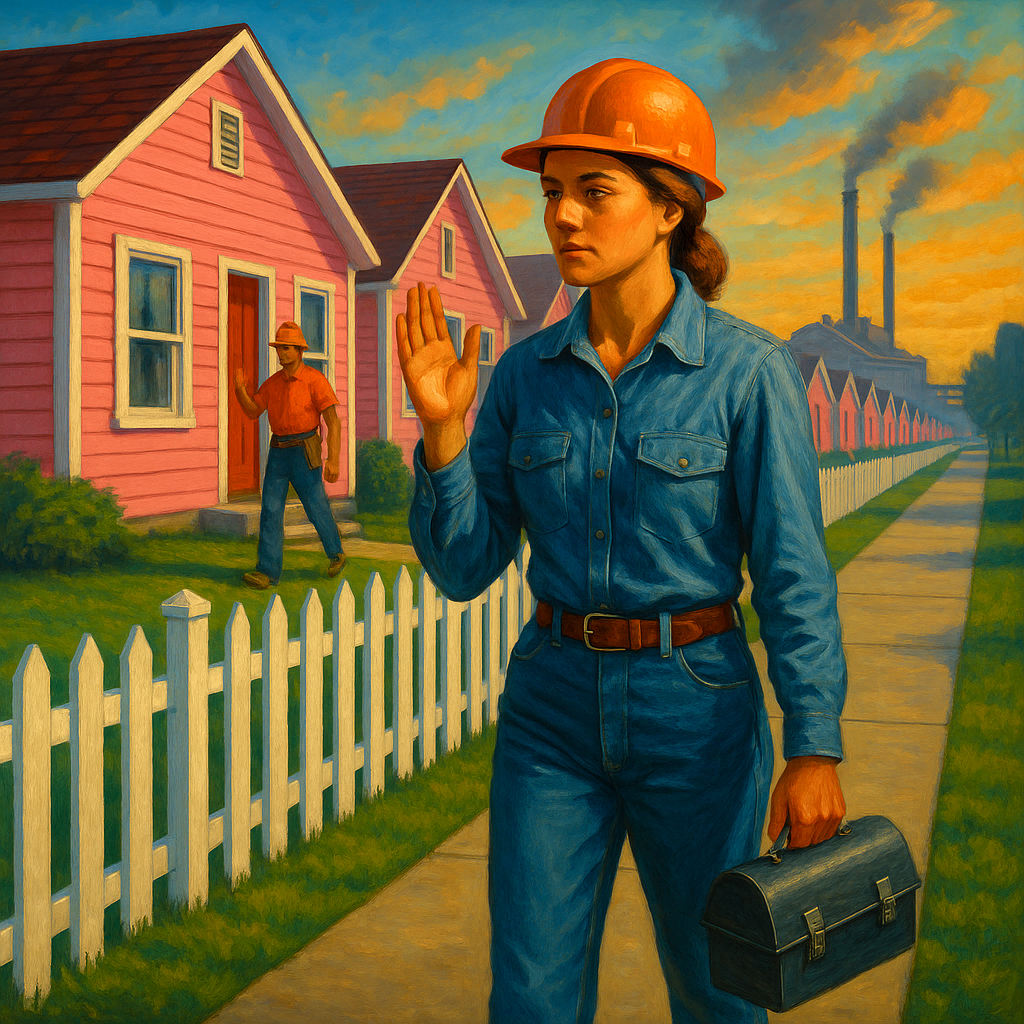
“Little pink houses” symbolize cheap, cookie-cutter housing, promised to everyone as part of the “good life,” delivered at the cost of individuality and opportunity. In post-WWII America, pastel-colored homes were pumped out like liquid and hardwood optimism – pinks, blues, greens as part of the cheery cookie-cutter American Dream aesthetic.
It’s a turnkey illusion of happiness in a prefabricated package. “Everything’s fine here!”
It’s a sardonic wink – you get your little box on the cul-de-sac, but maybe not the freedom, joy, or success you were told (or assumed…or thought) it would bring.
Think: “Here’s your pink house. Now HUSH.”
How are we different today from slaves in the Civil War era who worked all day for no pay but got food, water, shelter, and clothing provided to them? Now we’re told we are free, but all we really get to do is choose the job that does pay us a wage… And we are spending the majority of our income on – guess what? – food, water, shelter, and clothing. Are we really free? Or are we slaves to a system? “Freedom” now means working 9 to 5 and then arguing with Alexa for 45 minutes.
Right from the start, Mellencamp hits you with the verse that slices deeper…
“There’s a black man with a black cat livin’ in a black neighborhood. He’s got an interstate runnin’ through his front yard. You know he thinks he’s got it so good.”
It speaks to displacement, compartmentalization, systemic inequality, and environmental injustice from the git. He thinks he’s got it good, but he literally has a highway knifing through his life because the government is the only boss. We don’t own anything; the government owns you, and they’re charging rent in emotional exhaustion and exacting property taxes on hope.
“There’s a woman in the kitchen cleaning up the evening slop. He looks at her and says, ‘Hey darlin’, I remember when you could stop a clock’.”
I see this as a reference to how peoples’ value—especially women’s—is often tied to youth or beauty in this system. Also, this man has probably been coming home from work to this same house since he was 22 years old, and now he’s probably 50-something if “he could remember when” she could stop a clock. That suggests aging and class stagnation. So where has the time gone, and what changed in those 30 years? Did the system allow advancement? Or did it encourage contentment and silence?
“’Cause they told me when I was younger, they said, ‘Boy, you’re gonna be president’.”
This is a promise that never should have been made at all or ever again. Idealistic childhood dreams sold by parents or teachers are rarely realized by the working class (which is most of us, right?).
Pink Houses, for me, is just the quiet resignation that this is “just how it is.” We get what the system lets us have. Of course there are exceptions. Of course there are. But most people don’t get those blessings.
And I’m not necessarily saying I can relate (but I do!), but we’re not dreaming anymore. We’re just managing. Even if it sometimes feels like we bought the dream from Temu, some of us still try to color outside the lines. And maybe that’s enough.
Little pink houses… for you and me.
Ooh yeah.